
Itinerary
Tarquinia and Corneto
VISITING ETRUSCAN TARQUINIA: THE NECROPOLIS AND ITS SURROUNDINGS
The tour can be tailored to your group’s needs.
DINING IN TARQUINIA
Our group proposal for a lunch or tasting in Tarquinia: a typical venue in the enchanting old town or a farmhouse in the heart of the Lazio Maremma — ideal options for a meal before or after a visit to the striking Necropolis, the National Museum or the old town of Tarquinia.
Contact us for a quote.
ETRUSCAN TARQUINIA: THE NECROPOLIS
The first page of great Italian painting
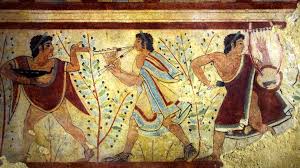
A pearl of exceptional cultural and archaeological interest, the Monterozzi necropolis holds a monumental cycle of painted tombs. This extraordinary series of paintings made the site a UNESCO World Heritage Site in 2004. The funerary chambers, modelled on the interiors of homes, have walls adorned with magical-religious scenes depicting funeral banquets, dancers, aulós players, juggling and landscapes, captured with lively, vivid colours and animated, harmonious movement. After the 5th century BC, figures of demons and deities join the farewell scenes, as the monstrous and the pathetic become more pronounced. The painted tombs represent the wealth and power of the deceased for whom they were made: they are the symbol of their high social rank.
The practice of decorating the tombs of aristocratic Etruscan families with paintings is also documented in other centres of Etruria, but only in the necropolises of Tarquinia does the phenomenon reach such a broad and continuous scale: it is attested from the 7th to the 2nd century BC, that is for almost the entire life of the Etruscan city. The importance of Etruscan painting is also linked to the total loss of Greek painting, of which we can form an idea through the decorations of some exceptional Tarquinian tombs, where the hand of Greek artists — drawn to Italy to decorate the tombs of wealthy Etruscans — has indeed been hypothesised.