
Itinerary
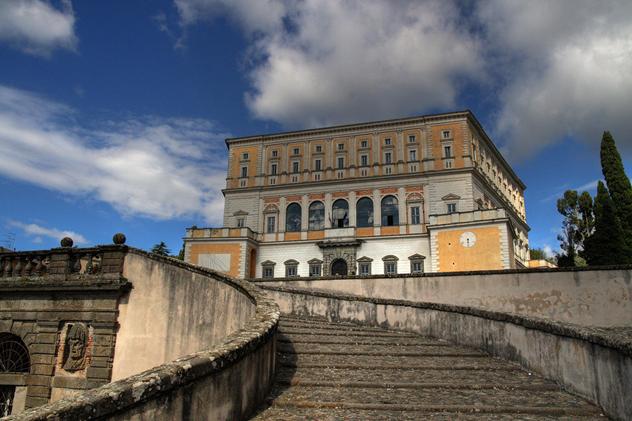
Palazzo Farnese in Caprarola
VISITING CAPRAROLA AND ITS SURROUNDINGS
Discover the Farnese splendour inside the palace and its magnificent gardens.
The tour can be tailored to your group’s needs.
DINING IN CAPRAROLA AND LOWER TUSCIA
Our group proposal for a lunch or tasting in Caprarola: a farmhouse in the Monti Cimini area, or a typical trattoria in Caprarola — ideal options for a meal before or after an excursion to Caprarola or other sites in lower Tuscia.
Contact us for a quote.
PALAZZO FARNESE IN CAPRAROLA
Palazzo Farnese in Caprarola is an imposing, majestic building set over several levels and one of the most fascinating examples of a Renaissance residence in Europe.
Palazzo Farnese in Caprarola is an imposing, majestic building set over several levels and one of the most fascinating examples of a Renaissance residence in Europe.
Originally conceived as a defensive structure, the palace was commissioned by Alessandro Farnese from Antonio da Sangallo the Younger, one of the finest military architects working in 16th-century Italy. Sangallo therefore designed a powerful pentagonal structure, but Alessandro’s interest in its completion waned when he became Pope in 1534.
Work on the palace was resumed by the pope’s nephew, known as Alessandro the Younger, about thirty years later. He chose Caprarola as a place to retreat from the bloody family struggles for power over the papacy. The healthy air and strategic position led him, in 1555, to commission the architect Jacopo Barozzi da Vignola, known as Vignola, to continue the construction.
It is at this point that the old fortress project was transformed into a sumptuous noble palace in full Renaissance style. Vignola’s remarkable achievement was to design a prestigious palace on the existing massive foundations of a military building, creating a splendid, harmonious whole.
The palace rises over five floors and its plan remains pentagonal, recalling its original purpose as a fortress. It is completed by a beautiful circular inner garden. One of its most representative rooms is the Room of the Maps, named after the frescoes depicting the world as then known from travellers’ accounts, painted by Giovanni Antonio da Varese.
The most important floor is the piano nobile, served by the royal staircase; it is divided into a winter apartment and a summer apartment for a total of 15 rooms, among which stand out the cardinal’s bedroom, called the Room of Dawn, and the Room of the Farnese Deeds, decorated with frescoes summarising the life of the Farnese family.