
Itinerary
The medieval heart of Viterbo
VISITING THE MEDIEVAL HEART OF VITERBO AND ITS SURROUNDINGS
The tour can be tailored to your group’s needs.
DINING IN THE MEDIEVAL HEART OF VITERBO
Our group proposal in the old town of Viterbo: a typical venue in the medieval quarter of the city of the Popes — ideal for a lunch, tasting or dinner before or after a visit to the heart of Viterbo.
Contact us for a quote.
THE MEDIEVAL HEART OF VITERBO
The evocative charm of an intact old town, through the city’s events between history and legend.
The old town of Viterbo is one of the most typical examples of medieval architecture.
The San Pellegrino quarter in particular, with its characteristic houses built on tufa, holds a fascinating succession of enchanting views. At its centre opens the square of the same name, overlooked by a church and the majestic Palazzo degli Alessandri. Built around the first half of the 13th century by the powerful Alessandri family, the three-storey building features an interesting variant of the typical Viterbo external staircase (“profferlo”), here built inside the perimeter wall rather than outside. The staircase is flanked by a parapet decorated with a diamond-star motif. Beside it is a portico on massive columns, behind which rises the Scacciaricci Tower, a four-storey tower-house.
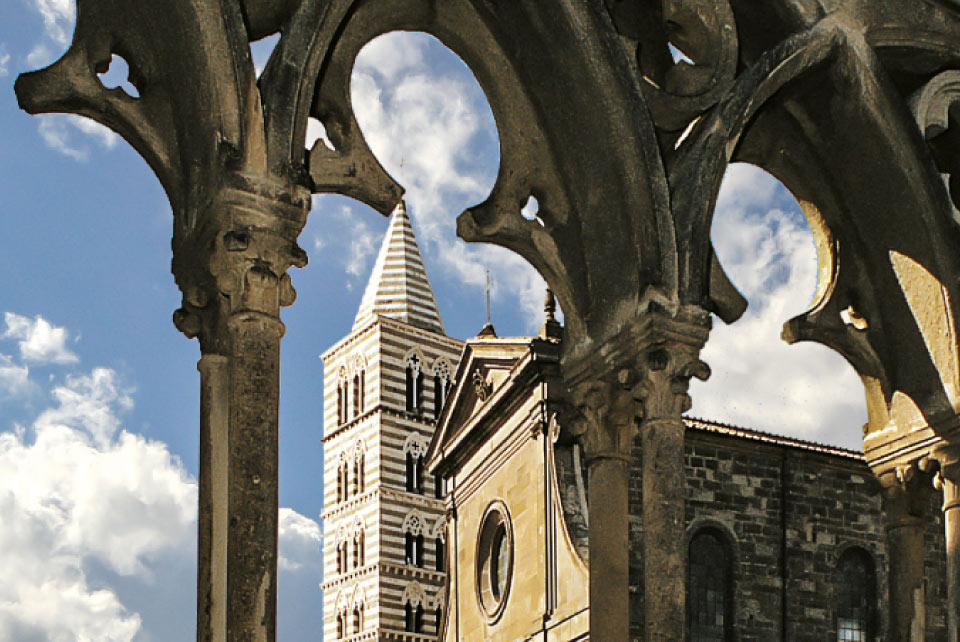
Speaking of Viterbo, the city of the Popes, it is impossible not to mention the grand Papal Palace. The Romanesque building dates from 1255, while the adjoining loggia was completed in 1267 in Gothic style. It rests on a wide vault, at the centre of which an octagonal pillar encloses a well feeding the fountain above. The basin panels bear the coats of arms of the Gatti family, Cardinal Raffaele Galeotto Riario, Sixtus IV della Rovere and Bishop Francesco Maria Visconti dei Settala.
Next to the Papal Palace stands the Cathedral of San Lorenzo. The church has an imposing Romanesque structure dating from the 12th century, although the façade — due to 16th-century alterations commissioned by Cardinal Gambara — appears Renaissance in style, sharply contrasting with the surrounding medieval buildings.
Another highlight of the square is the Palace of Valentino della Pagnotta, a wealthy late-medieval prior of Viterbo. It is one of the most interesting examples of private building in Viterbo, probably constructed in 1278 and remodelled in 1920. The second-floor mullioned windows are closely related to those of the Papal Palace loggia and are placed asymmetrically to the arches below; the arch plays a strong role both structurally and ornamentally.